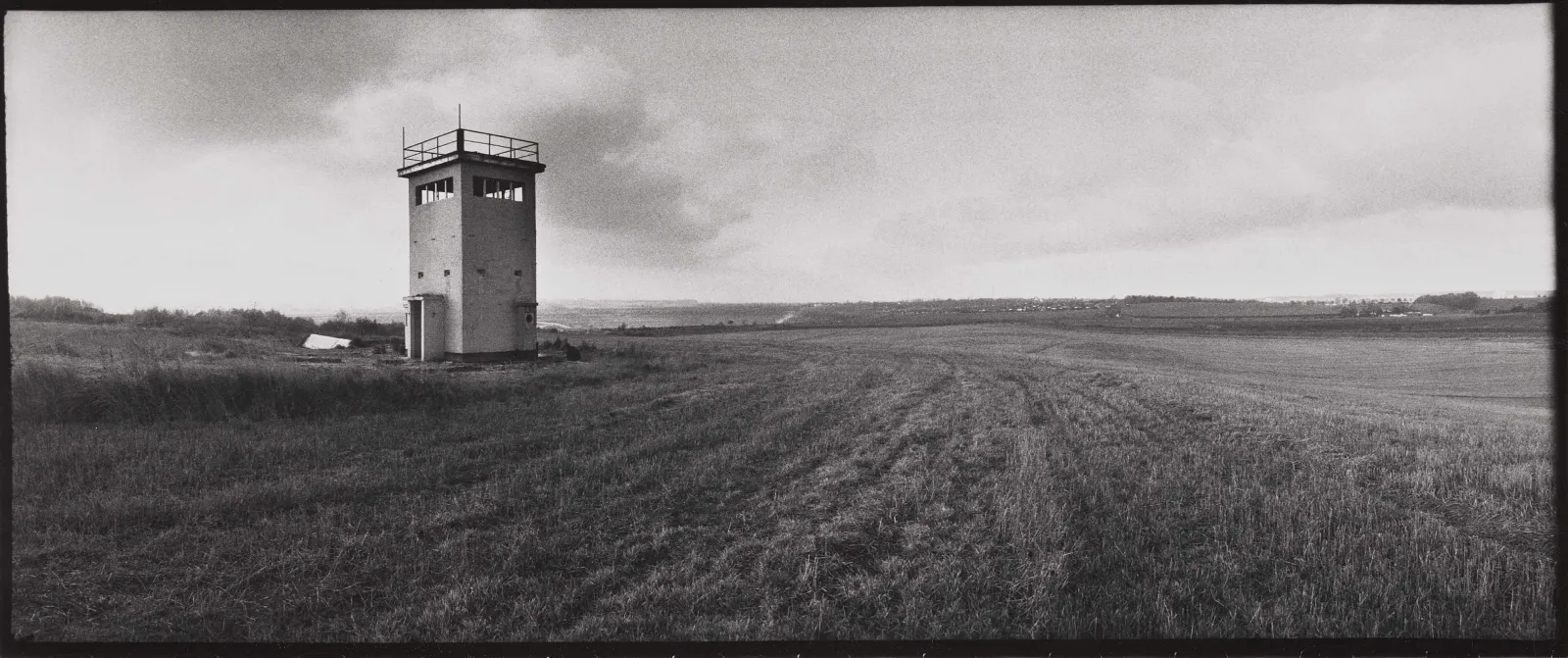
The Masterclass of f³ – freiraum für fotografie will present its work in the pop-up exhibition “Of palaces, mythical creatures and other encounters” at Haus#1 from May 8 to 10, 2026.
Through encounters with urban spaces, landscapes, nature, and people, the series—developed over the past twelve months by ten artists under the direction of Ingo Taubhorn—explore themes of memory, identity, and social transformation.
These images combine an interest in personal narratives with a readiness to test the boundaries of photography and venture beyond familiar territory. Consequently, the artists’ forms of expression include not only photographic displays but also film and installations. Their documentary approaches are frequently expanded through objects and printing techniques that experiment with material properties.
About the Masterclass leadership: Ingo Taubhorn is an artist and exhibition maker. From 2003 to 2023, he served as the curator of the House of Photography at the Deichtorhallen Hamburg. Throughout the masterclass, he guided the photographers in developing their own artistic positions, focusing on conceptualization, editing, narrative arcs, and forms of presentation.
Press Kit
Here you can download the press release and image material for the exhibition: ProtonDrive, 39 MB.
Exhibiting Artists
Jeremy Borger, Alfred Bouß, Hanna Boussouar, Andrea Brehme, Gregor Fischer, Dagmar Gester, Mila Hacke, Valentin Harnisch, Irina Kholodna, Oliver Ullrich
Jeremy Borger
The Sky Over Berlin Before the Builders Came
This series depicts the open sky above Alexanderplatz and captures a city that, under the influence of global capital flows, is on the brink of yet another redevelopment. The commodification of the sky, resulting fromnewly adopted building regulations, signifies a vertical transformation of Berlin.
Whilst international funds exert pressure on the property market and drive rents to unaffordable heights, the legislature enables the monetisation of the airspace. The TV Tower – once a monument to socialist ideology – now threatens to disappear behind glass façades.
The city is viewed from the ground up – in contrast to Wim Wenders’ film. Lines converge; the sky is reduced to a predictable profit margin. The space under pressure does not open up, but becomes more confined. It is getting dense.
Jeremy Borger works as an artist in Berlin and focuses on photography, text and film. He is a student of the OKS Masterclass. In his work, he explores how systems influence human behaviour and perception. His work has been exhibited across Europe.
Instagram @jeremys_shots
Alfred Bouß
And Lost Among the Subway Crowds I Try to Catch Your Eye
That first glance that changes everything. In the midst of the crowd, a fleeting moment, and yet: the world holds its breath. A moment of timelessness, a moment into which eternity breaks. But then eyes that look away. Like a child who covers their eyes with their hands and believes they don’t exist for others. Looking away as protection—or as cowardice. Sometimes it’s both.
The moment is a unit of time, shorter than the blink of an eye: it is more than just looking. Whoever looks away misses it. Whoever tries to hold onto it too long has already lost it. It demands presence. And yet every moment carries within it something that points beyond the individual—a gesture, a silence, a glance that carries the experience of generations within it. Imperceptibly. Moments pass when they are not seized. Stay a while! You are so beautiful.
And in the end—no reproach, no more questions. Only the quiet acknowledgment: Yes, it was worth it. Even if there is no longer love at first sight? But only love at last sight? What then?
Photographer, author, cultural manager, web designer since the early days, religious scholar, philosopher, publicist, communications professional, event manager—most recently: the camera. Lives and works in Berlin.
Instagram @alfredbou
Hanna Boussouar
LES ÉPHÉMÈRES
I am not a gardener. My garden does as it pleases. I watch it and photograph what I see. The creative abundance on my doorstep inspires me and provides me with material. I collect, dry, photograph, experiment; I make prints, cyanotypes, collages.
These attempts to preserve transience yield a smorgasbord of dried flowers, seeds, capsules, roots and fruits. Almost of their own accord, these come together in my ongoing series “les éphémères” to form hybrid plants and mythical creatures that exist only for the moment the photograph is taken. It is only at second glance that it becomes clear that these fleeting forms are not real. Yet one immediately recognises the inexhaustible creativity of nature, which persists even in decay.
Hanna Boussouar, born in 1979, lives and works in Berlin. Whilst her commissioned work as a trained photographer tends to focus on people, their surroundings and their work, her artistic practice primarily explores themes such as nature and transience.
Websites: boussouar.com | folioscope.org
Instagram @hannaboussouar
Andrea Brehme
Das hellblaue Haus
I simply couldn’t stop taking photographs. Spaces that seem to have fallen out of time. Images. Realities that lie in what unfolds between reality and memory, between dream and waking.
A merging of worlds – entirely real in feeling.
It is a work of phases.
Corona plays a part, the sudden encroachment on personal freedom, the standstill.
Death plays a part. A frenzy of work and a shoulder that feels frozen.
The aftermath plays a part, a headlong rush forward or a retreat. Cracks and divisions. A fairy-tale idyll.
Andrea Brehme, born in Berlin-Tempelhof in 1965, works as a freelance artist in Berlin and the south of France. Her work has been exhibited at venues including Kunstquartier Bethanien and f³ – Freiraum für Fotografie. In 2024, she received an award in the ‘German Photobook Prize 2024’ competition for her book project REFERENZ, which was supported by the ‘Stiftung Kunstfonds’.
Dagmar Gester
Altissima
My artistic practice is guided by the leitmotif of Heimatbedarf – the human need for home and belonging — and engages with precarious, contradictory and contested forms of belonging. One symbol of this is the tree of heaven, at the centre of my work Altissima. Introduced to Europe as an ornamental tree in the colonial era, it is now seen both as a beneficiary of climate change, a disruptive presence and an urban survivor.
For Altissima, I combine geotypes with photographic images of the tree and the urban landscape. In the geotype process I have developed the tree’s habitat inscribes itself into the paper as a shared urban living space. What interests me about the tree of heaven is the way it embodies migration, adaptation and resilience, while also raising the question of who space belongs to and what is considered to belong in the city.
Dagmar Gester lives and works in Berlin. She is a visual artist specialising in photography and has for many years been developing projects at the intersection of photography, materiality and social space. She studied political science at the Free University of Berlin. Her work has been shown in numerous solo and group exhibitions in Germany and abroad, including in Berlin, Copenhagen, Rome, Havana and Milan.
Website: gester.eu
Instagram @dagmargester
Gregor Fischer
Dalej, Dalej
Eight years ago, a personal encounter first brought me to Poland. I did not stay, but I kept returning. What began as an individual motivation grew into a deeper curiosity about people and everyday life.
The photographs were taken along the way: fleeting scenes in which retail spaces, street corners, and public squares become stages, and people become actors.
Rather than offering clear answers or complete narratives, they show fragments where my gaze came to rest. The camera here does not serve to explain, but to share attention: it records what happens and seeks to invite us to ask better questions within the ordinary.
Born in Berlin in 1989, the powerful images of that turbulent time shaped my early passion for visual storytelling. After training as a video editor, I became a freelance photographer in
2011. I work worldwide for news agencies, newspapers, magazines, companies, and NGOs.
In recent years, my focus has gradually shifted from news photography to documentary work, driven by personal interest and a more open perspective.
Website: fischergregor.com
Instagram @thegregorfischer
Mila Hacke
Zoo Palast Berlin
The cinema is a place that brings people together and transports them to another world. My illusionist photo series builds on my first job after leaving school. I worked as a projectionist at the Filmkunststudio Schlüter. My precise perspectives capture the cinema auditorium before the film begins, adopting the viewpoint of someone arriving.
I am interested in human perception in a cinematic manner: immersing oneself and taking in the entire field of view, whilst simultaneously focusing on details. Photography translates this spatial and personal perception into a two-dimensional staging in the form of a series of images.
Mila Hacke (Dipl. Arch., M.A. Arch.) is an architectural photographer and curator with a holistic, conceptual approach to architecture. Born in Berlin in 1973, she has been developing exhibitions on post-war modernism and contemporary history for over 15 years. In 2012, she was a Rome Prize winner at the Casa Baldi. Her photographs are held in public collections. She is committed to building culture both professionally and on a voluntary basis.
Websites: milahacke.de | alliierte.berlin | souvenirs.berlin
Instagram @architektur_foto
Valentin Harnisch
Der Ort, wo Papa wohnt
In my work „Der Ort, wo Papa wohnt“ („The place where dad lives“), I return to the setting of my childhood. I wander through the town in search of identity, of familiarity or alienation. I ask myself what home means to me. Is this my home? Does it mean anything to me? Why does it mean anything to me? I search for a sense of belonging and wonder if it ever truly existed. Have I ever really felt at home here? Can I identify with this place and its people?
For 24 years, I lived in the village of Schwanebeck on the northeastern outskirts of Berlin. Moving away a year ago left me with a feeling of being uprooted. I keep returning there to take photographs and explore this feeling.
Valentin Harnisch, photographer, was born in Berlin in 1997 and spent his childhood and teenage years in Schwanebeck, Brandenburg. He works as a photographer and retoucher and is a technical assistant at the Lette Verein, where he also completed his training as a state-certified photo designer in 2022. In his work, he focuses on the themes of memory, heritage and personal identity. He has been living and working in Berlin again since 2025.
Instagram @valleharnisch
Irina Kholodna
Zwei Bilder
My photographic work focuses on urban spaces and landscapes. I find it difficult to describe this work, because what I value most in good photographs is precisely that they cannot be fully put into words. I am interested in images in which seemingly little or nothing spectacular is happening, yet which still have a distinct presence. Often, it is subtle moments, a certain atmosphere, a particular light, or a mysterious tension that, for me, carries an image. For this exhibition, I have selected two works: ‘Görlitzer Park in Winter’ from the series ‘New Pastorals’ (2016) and ‘Two Fishermen’ from the Ireland series ‘A Door to the Garden’ (2022).
Irina Kholodna is originally from Ukraine and lives and works in Berlin. After studying mathematics and completing a PhD in Ireland, she turned to photography and artist books. She develops her projects as photographic series and handmade books in small editions.
Website: irinakholodna.de
Instagram @irinakholodna
Oliver Ullrich
Species
In the forest, I come across things that seem like small beings. Found objects, shaped by moisture, light, temperature, wind, and the quiet work of time – by everything around them. I photograph them, place them in display cases, letting them float lightly, like preserved specimens that keep their order yet remain strange. Each form holds its own story, its own secret. I can show them, but I cannot explain them. What remains is their quiet presence – the indefinable, the living – suspended between observation and imagination.
Oliver Ullrich, born in 1960, studied biology and worked as a professor of molecular biology and cell culture technology in Hamburg. Since 2020, he has been working as an autodidact photographer at the intersection of science, nature, and art. He has participated in photography masterclasses with Andreas Herzau, Nadine Barth, Peter Bialobrzeski, and Ingo Taubhorn. Photo book “Synaptic Landscape”, 2024, Kerber Verlag.
Website: oliverullrich.de
Instagram: @oliverullrich.photography
Framework program
☞ Sign-up for PiE’s free, weekly Newsletter and stay up to date!
Friday, May 8, 2026, 7 pm
Opening reception
Saturday, May 9, 2026, 4 & 5 pm
Artist Talks (de)
Sunday, May 10, 2026
Finissage


Exhibition Venue
Haus#1
Waterloo-Ufer · 10961 Berlin
Opening hours for this exhibition: Fri – Sun 12 noon – 8 pm
Admission free